
Courage Cannot Claim Transparency While Denying Its History — and Gay Catholics Are Not “Wounding” the Church
Plus, Liberation Theology as a Way Forward

The recent publication of the Synod on Synodality’s Study Group 9 report (as I wrote about last week) has continued to provoke intense responses within the Catholic community: not simply over sexuality, but over whether gay Catholics are allowed to speak honestly about their lives at all – without being accused of “wounding” the church.
As a reminder (that the executive director of Courage himself apparently needs to hear), the report is not magisterial teaching. It does not change doctrine or overturn the Catechism. Like the broader Synodal process initiated by Pope Francis, its purpose is consultative and pastoral: to listen, discern, and reflect on the lived realities of Catholics around the world (spoiler: this includes gay Catholics – and other members of the queer community who weren’t included in this report).
In the report for Study Group 9, one testimony in particular has provoked outrage.
The testimony in question is from a married gay Catholic man who described his experience within Courage as spiritually isolating and at times harmful. He spoke about how the ministry’s emphasis on confidentiality, sexual “struggle,” and sin-centered language often left him feeling that his life and relationships could only be discussed in terms of disorder or shame, rather than integrated as part of his full human and spiritual reality. He also reflected on encountering pastoral approaches outside of Courage that allowed him to experience faith, community, and his sexuality without secrecy or fragmentation.
The backlash to this testimony illustrates how quickly gay Catholics are accused of harming the church simply for speaking honestly about their lives.
How exactly did Courage respond to this testimony?
First, there was a press release, wherein Courage alleged the report was an act of calumny and detraction. Then, the EWTN-owned National Catholic Register published a longer interview with Courage executive director Father Brian Gannon. Because others have already examined the press release, I will spend most of my time in this essay looking at the interview.
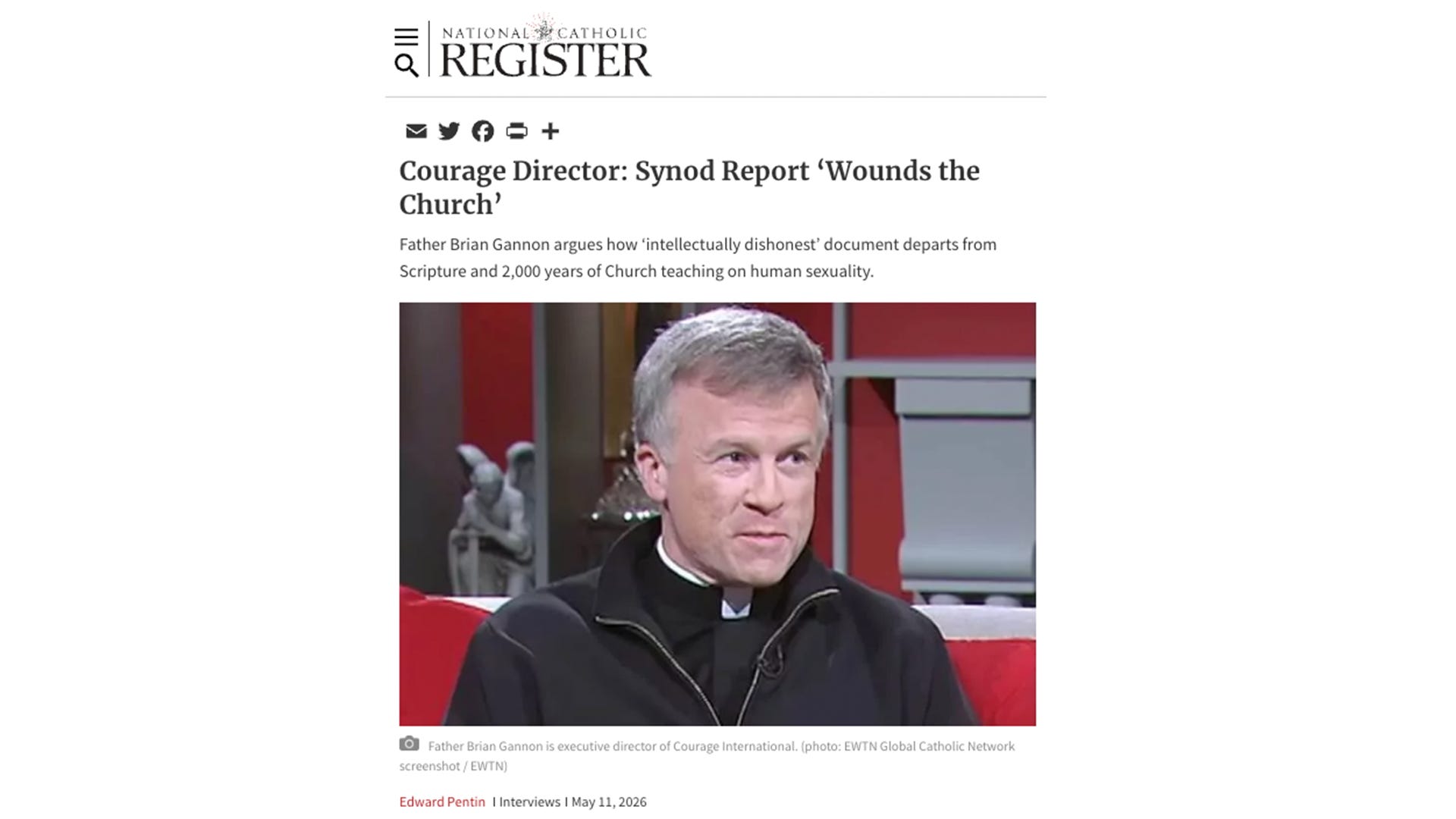
Fr. Gannon claimed that the Synod report was “intellectually dishonest” because Courage representatives were not directly involved in the process. It is very strange to imply that a person’s real, lived experience is “dishonest” simply because it conflicts with an organization’s preferred self-image.
It is also worth noting what lack of involvement actually means in this case. Courage leadership has already had the same opportunity to meet with Pope Leo that Outreach founder Father James Martin had. And the actual structure of Courage is purposefully designed to be private, and therefore unable to accommodate “involvement” in a process that requires openness and transparency.
So the organization is arguing on the one hand that it must be formally represented in Synodal listening processes (which… no one was stopping them from participating in the Synod in the first place) in order for those processes to be legitimate. On the other hand, it maintains a confidential environment in which members are discouraged from public visibility and where lived experience is meant to remain contained (one might even say, “hidden”) within certain protected settings. Courage is effectively demanding inclusion in a public dialogue while sustaining a culture in which members are not expected to speak openly using their own names.
Denial instead of Accountability
Another key element of Courage’s response is the refusal to engage the substance of the testimony itself. There is no sustained grappling with what was described, no serious attempt to ask what might be learned, no pause to consider whether something real and painful might have been expressed. Instead, the response moves almost instantly to denial and defense.
And denial, particularly in moments like this, is never a neutral act. It is a signal. It tells us less about the individual gay Catholic, and more about an unwillingness to be changed by what that person says.
Of particular note regarding denial is Fr. Gannon’s fourth assertion: “Courage does not engage in reparative therapy; this is false.”
But Chris Damian’s recent essay documents how Courage’s founder, Father John Harvey, openly promoted ex-gay and reparative therapy frameworks for decades, drawing heavily from figures such as Joseph Nicolosi and other conversion therapy advocates. Damian also notes Courage’s historical promotion of ex-gay conferences, literature, and ministries connected to the broader sexual orientation change movement.
One can debate how much Courage has evolved since then. But to act as though these connections never existed is historically inaccurate.
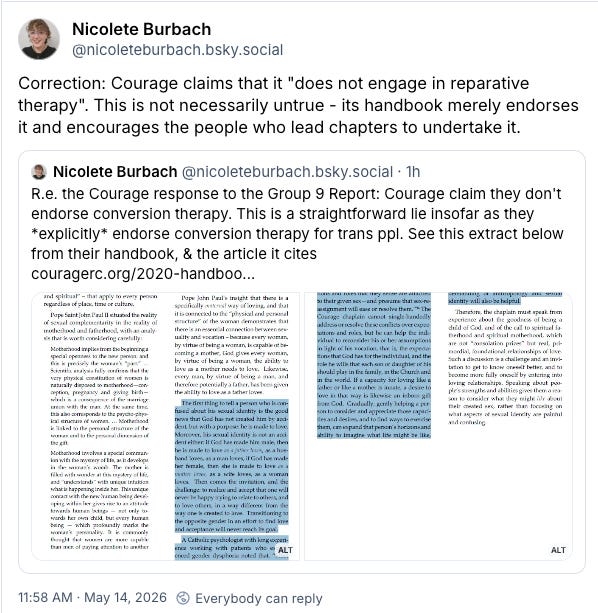
UPDATE: Nicolete Burbach has also provided information on Blusky directly from the Courage handbook endorsing conversion therapy for transgender people.
Is the church really “unchanging?”
Several times, Fr. Gannon invoked the idea of “2,000 years of Church teaching” as though Catholic theology has existed in a static vacuum for centuries. But this is not how church history actually works. Catholic tradition is living and dynamic, and evolves along with human understanding. The church’s stances on slavery, religious liberty, democracy, biblical interpretation, and relations with other faiths have all developed significantly over time.
Even the modern concept of “homosexuality” did not exist for most of Christian history. As Damian correctly observes, contemporary Catholic language around “homosexual persons” emerged alongside twentieth-century psychological categories that frequently treated queer people as pathological or developmentally disordered – views no longer considered acceptable or mainstream by psychologists today. The theological frameworks many conservatives now defend as “timeless” were themselves shaped by false assumptions about psychology, gender, and sexuality.
This does not mean that doctrine itself is meaningless or infinitely malleable. But it does mean that these appeals to “2,000 years” are often less about getting the history right and more about shutting a conversation down before it even begins (kinda like trying to throw out the whole Synodal report when you didn’t even bother to participate in the first place).
Queer and transgender Catholics know this dynamic intimately.
We are frequently told that our existence threatens the church, wounds the faithful, or undermines morality merely by becoming visible. Yet, what many LGBTQ Catholics have actually experienced is that silence wounds far more deeply than honesty ever could.
Courage insists its emphasis on confidentiality is a form of pastoral sensitivity. But many queer Catholics experience these environments not as liberating, but as spiritually claustrophobic: places where queerness is tolerated only insofar as it remains hidden, unnamed, and permanently framed as tragedy.
That is why liberation theology offers such an important framework for this moment.
Liberation theology begins not with institutions protecting themselves, but with listening to those pushed to the margins. The poor, the sick, the disabled. Queer and transgender liberation theology asks what it means to encounter God through lives that the church has often spoken about more than spoken with. It recognizes LGBTQ Catholics as people capable of revealing something essential about God.
Trans Catholics especially understand what resurrection can feel like in concrete terms: the struggle to survive rejection, the longing to become whole, the experience of moving from invisibility toward truth. These are not experiences foreign to Christianity. They resonate deeply with its central mysteries.
And if the church truly believes every human being bears the image of God, then LGBTQ Catholics cannot remain perpetual outsiders to our own spiritual communities — tolerated only when hidden, spoken about but rarely trusted, invited to suffer but rarely invited to lead.
The future of LGBTQ Catholic pastoral ministry cannot be built on secrecy, fear, or denials of historical realities. It must be built on honesty, encounter, accountability, and the radical Gospel truth that no one is outside the reach of God’s love.
Not in the shadows.
In the light.
I went to Courage in high school at 18 and the shame/self-blame in that room, by that priest facilitating, was even murkier than the waters I was already wading in. I’m soo glad I never committed to the group further than a few meetings