

Empathy has become a battleground in the culture wars. At least two books have helped fuel the fight: Gad Saad’s Suicidal Empathy: Dying to Be Kind, which argues that empathy has become a destructive force in Western society, and Allie Beth Stuckey’s Toxic Empathy: How Progressives Exploit Christian Compassion, which makes a similar case from within the Christian right. Now Bishop Barron, a Catholic bishop who has become increasingly prominent in Online Culture-War Catholicism, has weighed in — and, spoilers: not on the side of empathy.
In his recent podcast and then also in a video homily posted for September 6th, Baron spoke favorably about Saad’s conclusions in Suicidal Empathy: a book built around the rather extraordinary premise that our desire to understand and alleviate the suffering of others can become so morally dangerous that it threatens the society doing the empathizing. Barron adopts this basic framework, warning that empathy can detach us from reason and objective truth and lead us, in the name of compassion, toward the deeply harmful conclusions of extreme post-modernist critical theorists. Further, Barron argues that contemporary “wokeism” has replaced Christian love with empathy, suggesting that Christianity has lost its cultural centrality (a claim he makes largely based on vibes, without providing evidence), and a postmodern ideology has moved into its place.
In his telling, this new ideology denies objective moral and epistemic truth, leaving us with little more than competing subjective perspectives. What remains, then, is empathy: an imperative to understand one another and a primacy on the need to “avoid hurting one another’s feelings.” Barron’s solution is to recover what he calls in the homily the “hard-edged language of love”, (surely a somewhat ominous response to empathy), and to state that Jesus and St. John would certainly have never said “God is empathy” in place of “God is love.” The semantics he articulates here would make a more compelling point if the word “empathy” had actually existed prior to the 1900s.
Of course, Christian love is certainly more demanding than mere sentimentality. The Gospel does not tell us simply to make one another feel good, and love cannot be reduced to emotional identification with another person — in part because this can be imagined. We can imagine that we understand how another person feels without ever actually talking to them. This error occurs without the actual encounter that is central to the life of Jesus and his statements about what love actually means. Barron’s argument implies that listening to the experiences of marginalized people is somehow a competing moral framework, imported into Christianity from the outside by “wokeism.”
Actually, the Catholic Church already possesses a deeply developed tradition for what it means to encounter the other and to hold firm moral principles about how we ought to live and treat each other. It is called Catholic Social Teaching, and at its center is not empathy, sentimentality, or even Barron’s preferred fortress-style description of love, but the inherent dignity of the human person.
Barron seems to have allowed the culture war to convince him that listening to marginalized people is a waste of time when he already knows how best to love them. Catholic Social Teaching makes room for the process of discernment and encounter that actually leads to love. Human dignity belongs to every person and the church’s task is to recognize, promote, and defend that dignity in the concrete circumstances of human life. Pope Leo XIV has made precisely this point in his first major social encyclical, Magnifica Humanitas, where he describes Catholic Social Teaching not as a static handbook of principles to be imposed upon history, but precisely as that process of discernment that is directly born from encountering the other.
Want to learn more about Magnifica Humanitas? Check out my overview of the wonderful new encyclical below:

Discernment and encounter do not require Catholics to abandon objective truth in favor of subjective experience. They require Catholics to take objective truth seriously enough to ask what it means in the lives of actual people.
How do we define Human Dignity?
Fr. Bryan Massingale, a Black Catholic priest and Professor of Theological and Social Ethics at Fordham University, offered a particularly powerful account of this tradition in a recent lecture on Catholic Social Teaching. Fr. Massingale begins with the recognition that Catholic Social Teaching exists precisely to bring the insights of Scripture and Christian faith into conversation with the social, political, and economic conditions in which human beings actually live. The tradition began formally with Rerum Novarum, (written by Pope Leo’s namesake) in 1891, but it has continued to develop as the Church has confronted war, racism, poverty, migration, environmental destruction, economic inequality, and other circumstances that affect human flourishing.
Fr. Massingale identifies the life and dignity of the human person as the foundation of this entire tradition, just as Pope Leo does in Magnifica Humanitas. Every person is created in the image and likeness of God, and therefore possesses a sacred, intrinsic, equal, and inviolable dignity that does not depend upon accomplishment, wealth, social position, race, gender, geography, or conduct.
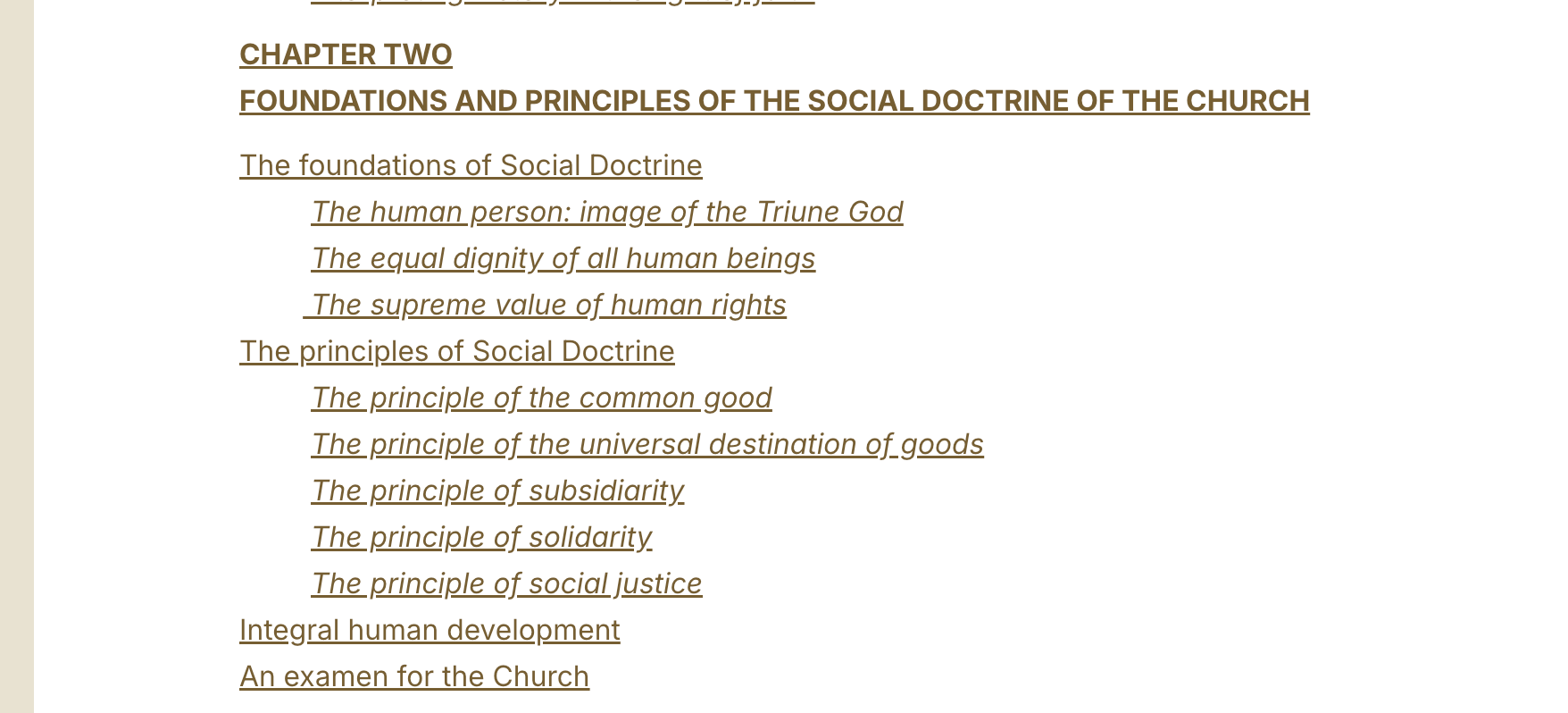
We do not give people dignity, Fr. Massingale explains; God has already given it to them. Our responsibility is to recognize, promote, and defend what God has already done.
In Magnifica Humanitas, Pope Leo writes that human dignity does not depend upon a person’s abilities, wealth, position, or even the rightness of their choices. It is a gift that precedes all of these things because every person has been willed, created, and loved by God. The dignity of the human person is therefore not something that must be earned or justified, and no human power can legitimately deny it. This is not a new progressive innovation within Catholicism, nor is it a concession to contemporary cultural politics. It is one of the deepest convictions of the church’s social tradition.
Once we begin there, the problem with Barron’s argument becomes clearer. Empathy does not replace love; rather, love requires us to take seriously what another person tells us about the ways their dignity has been wounded.
Fr. Massingale describes the danger of treating human dignity as merely an abstract principle. It is easy, he says, to accept the dignity of the human person in theory. The harder question is what that principle means when we encounter real people and real circumstances. Catholic Social Teaching therefore asks us to evaluate social, political, and economic decisions according to what they do to people, what they do for people, and what they enable people to do for themselves. Fr. Massingale argues, “People, not issues, are central and sacred.”
Conclusion
Barron’s “wokeism” framework risks turning people into political issues: immigrants become immigration, Black people become racial politics, poor people become economic policy, and transgender people become gender ideology. Catholic Social Teaching calls us to do the opposite—to see the person behind the issue and take seriously the conditions in which they live. That does not mean treating every personal experience as an infallible moral argument or abandoning the church’s belief in objective truth. If we believe that every human being bears the image of God, then we have a moral obligation to encounter human beings as more than abstractions or categories and to take seriously what they tell us about the conditions in which they live.
Barron’s invocation of “wokeism” gives him a convenient intellectual category into which he can place almost any challenge to his ideas about authority, culture, or morality. But the Catholic tradition at its best is not afraid of asking whether established arrangements actually serve the human person. Indeed, much of Catholic Social Teaching emerged precisely because the church recognized that existing social arrangements could contradict the dignity of human beings — and that’s also why the Pope is still talking about this today.
We cannot determine what it means to will the good of another person while refusing to encounter that person as a concrete human being. Love that never listens can become remarkably paternalistic. It can become the declaration that I already know what is good for you before I have bothered to understand who you are, what you have experienced, or even what you have to say.
Perhaps Barron is right that empathy is not the same thing as love. But that does not leave us with his culture-war alternative, in which “wokeism” has supposedly displaced Christianity and marginalized people have become the agents of a postmodern assault on objective truth.
We have another alternative, and it is older than America’s culture war. The bible itself tells us that every human being is created in the image and likeness of God. Every human being possesses a dignity that cannot be earned, surrendered, or taken away. Our responsibility is not to bestow that dignity upon anyone, but to recognize it, protect it, and defend it. And when the people whose dignity is most vulnerable to being ignored tell us that something is wrong, the Catholic response should not be to accuse them of importing a rival ideology. Our response should be to listen. To encounter. To love.
BLESS YOU for this.
Love this. Thank you for introducing me to Fr. Massingale!