

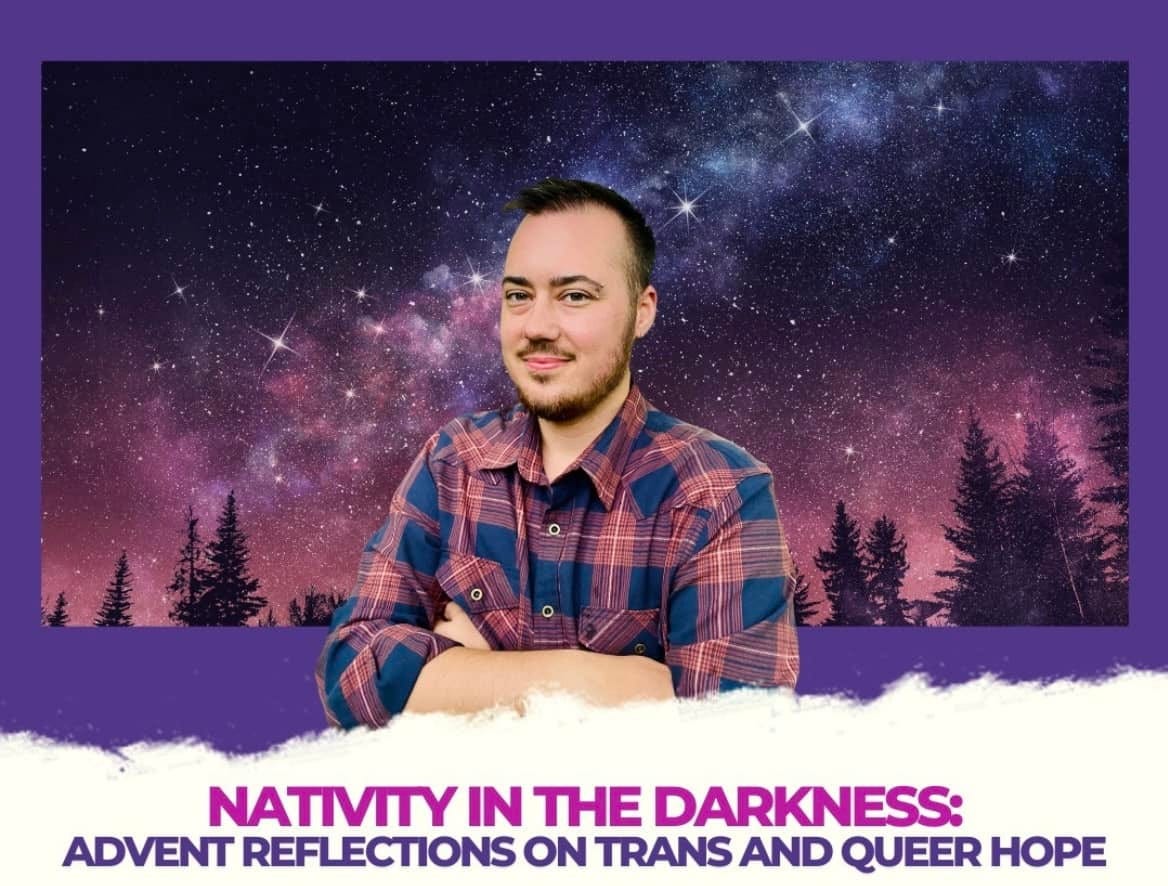
As we enter the season of Advent in preparation for the coming of Christ, I have been reflecting on the profound ways that embodiment has been a part of my spiritual journey as a transgender man. In this season of waiting and anticipation of the incarnation, I am honored to share with you a reflection on this topic of transgender embodiment—an exploration of how our bodies, in all their complexity and beauty, reflect the image of God and how queer people in particular participate in the divine mystery.
In collaboration with Dignity USA, I offer this reflection as an invitation to embrace the incarnational beauty of our embodied experiences as queer people. Whether you engage with the recorded version or the full written transcription below, I hope this reflection will deepen your understanding of the sacredness of all bodies, and provide a space for dialogue on the intersection of faith, identity, and the powerful hope we find in the Advent season.
May this time of waiting open us to the fullness of who we are, both as individuals and as beloved members of the body of Christ.
Full written transcription of this reflection:
So I am very excited to be sharing today and talking and reflecting on this theme, “Nativity in the Darkness, Advent Reflections on Trans and Queer hope.” It's a topic that has so many related thoughts. I feel we could talk for hours probably on most every element in there, which is just really exciting because I really love digging deep into queer theology. What I would really like to accomplish in our time that we have together today is: I would like to make an argument for LGBTQ participation in the mystical power of the incarnation, while also sharing some examples and stories from my own life to fill it out and give more context.
So to begin with, for me, a a huge source of hope and a huge moment of spiritual transformation was in transition. It changed so much about how I experienced the world, how I experienced other people, how I experienced the church, and how I experienced God. In the Advent story, one of the things that stands out to me the most is that so many people were anticipating the coming of Jesus, but had the wrong idea about what it was going to be. So many people thought—and it was, you know, often like the kings and the important people—they thought, “Okay, this is gonna be like a conquering hero guy who's gonna come, the messiah. He's gonna change everything and make everything go according to our our favor. Go our way.”
And in that focus on believing it was gonna be a certain way, they actually ended up missing out on the reality of this quiet, humble birth in a stable. And that missed opportunity or not seeing what was really happening, feels intimately related to the experience of being a queer person in a church. Because so often, maybe it's the church hierarchy, maybe it’s people of status in the church or people of authority; important people in the church don't see queer people for who they are in the pews. And so because of not seeing us for who we are, they deeply miss out on all of the gifts and all of the beauty that we really do bring.
And so, when I was growing up Catholic, I was very much focused on, making sure that I did the role that I was assigned correctly. And so that was everything from the, you know, on paper, I'm gonna go down the checklist. I'm gonna do all of the things that ensure that I am the right type of Catholic, that I am a good Catholic. Like, that's my goal, to get this little certificate, get signed off on kind of. But, also, that included for me the performance of trying to be a woman. And, you know, it was never a good fit. But I really did try to compromise in the ways that I could in order to fit this role, fit this performance.
But one of the things that I experienced in finally coming to terms with my trans identity and embracing it was I realized that I had all these connections with all of these people. But in none of those connections was I actually showing up as myself. And so they were inherently superficial, and it wasn't really the other people's fault. It was because I'm not really showing up. So I'm not really able to bring my full gift into relationship with these people.
That ties into another element I wanna talk about, which is the spiritual journey itself and how, you know, there's the connection here between Advent as the spiritual journey, and then transition as a spiritual journey. You have the three different stages of the spiritual journey where it's like, first, you have sort of the “status quo” level, then you have the “confrontation” moment, and then you have, like, basically “the fruits.” So if you can make it through all of that, you get to these amazing beautiful fruits. And so for transgender people, it’s often visual. For me as a binary transgender person, it was a it was a very visual, physical; there were external changes that you can see. You know, my appearance changed. I grew hair on my face. My voice deepened.
There's the physical embodiment piece is there represented in that way. And for the the stages, you know, starting in the status quo, that's where I was still trying to play these roles, still trying to perform, perform femininity, perform this idea of what it meant to be a good Catholic. And then going into the confrontation for me was really, do I really want to just be, like, a shadow of a person, and have these shallow connections? And the answer was no. I want something deeper.
I want something more true. If all of these things that when being taught about God's love and the consequences of God's love are true, then I want to be able to truly pursue them as authentically me. And then, into the fruits, which I really, I almost don't have words, when I think about how many spiritual fruits I have received and experienced from my transition because there's just so many… with the personal relationship with God, which I just did not know it could be that deep from before because that shallow relationship I had with other people extended to God. And so now it just feels like… it feels limitless. It feels like there is always more to know, always more ways to grow.
And then, additionally, there's other spiritual fruits as well because finding and meeting people and and community like we are sharing here where being welcomed as your true self, that the power of that, not only profoundly changed me in nourishing me and strengthening me, but, you know, as we go through periods of darkness, having those connections, is really like I think of it as, like, different threads… all these different connections and these different people that I've met mentors, peers in in Catholic LGBTQ world. It's like all these different threads woven together, and I think of it as, like, a tapestry of resiliency that I've received. And so, in undertaking this, spiritual journey, that's when I came face to face with some essential questions about darkness. So, like, why does darkness exist? Is it possible to overcome darkness? And, also, you know, if god is real, why doesn't he get rid of darkness? Why doesn't he just banish it and and just completely defeat it?
And, also, there were very difficult things happening, you know, in the in the first stages of the journey. There were difficult things happening to me in my transition. For example, I'll give you a list of some of the things that happened.
When I called my parents and came out to my mom and dad, my mom said “transgender” is a political word and essentially hung up. I was originally supposed to be in my sister's wedding, and then when I came out as trans, I was basically informed that they wanted to only have a female maid of honor, so I was not in the wedding anymore. I came out to the boss that I had at the time, and told him, you know, very professionally. I was like, this is the thing that's happening, and I have started testosterone. And I would like to get ahead of this and email everybody and, you know, just establish I'm gonna be using a new name and pronouns, etc, to which he responded, “do you realize the position you're putting me in?” So that didn't go very well.
And then, of course, I did lose a lot of the friendships that I had, and the support that I had in the conservative Catholic world, which is kind of what I was in back then. And really, when I say support, it wasn't just, you know, something that I did on Sundays it was my whole life. My whole life was built up of all these people because it was always like, okay. You need a car mechanic who is a good conservative Catholic that we know that we can trust to be that person.
And so it was really it was a big, big loss obviously. But, I did wanna also note that, even though these things were very difficult for me, these are not the worst things or even the most extreme things that could possibly happen to a transgender person in coming out. But I really just wanted to also acknowledge that the darkness can be very fraught and and take many different forms for different people as well.
And so for me, during that time going through all of that, part of what made that time challenging as well was the way that transition itself had kind of turned things upside down in how I saw the world, and it made me question things that I used to see as “light.” And so, in asking these questions about “darkness and light,” I started to focus in on, just really examining things that I had been taught, things that I had just always taken for granted.
And so as I began the process of examining those things, of analyzing and trying to figure out what still resonated with me as these big changes happened in my life, I started to notice, the pattern of all these very binary and dualistic systems. So we have things like “before and after,” “good and bad,” “male and female,” “light and dark.” And so my transition was challenging these very simplistic ideas, like “this or that,” the idea that there can only be these opposing polar things, that there's no space for a gray area in that way of looking at things.
And related to this, I also started to think about how, you know, we may be living as human beings in this linear chronological flow of common, but God is not confined to that. And so, if we look at the Eucharistic celebration, for example, that is something where we believe that, you know, that all past, present, and future Eucharistic celebrations are all sort of referencing to and, returning to the actual last supper.
And relatedly, the crucifixion as well, and the incarnation. So these significant moments in the life of Jesus are inexorably and supernaturally linked together. So the incarnation of Jesus illustrates an essential oneness that transcends time, transcends the binaries, transcends gender, mystically bringing together humanity and divinity, again, something else that would often be seen as opposed, in a way that permanently surpasses our limited dualistic perspective. And, of course, we also believe as well in a mystical union of three in the trinity, and we know that all things work together for good. You know, that's Romans 8:28.
And so, ultimately, it's not about this messianic, warrior conquering hero that everybody was expecting, and it's not about simply defeating or destroying darkness. As facets and reflections of God's love, our unique roles are about magnifying that love by being most authentically ourselves. For me as a transgender person, much of that just means living the the truth of of being who I am, just embracing my identity and being honest about it. And in that way it's connecting to people in the truth of that reality. You know? So something that transcends just, “oh, yeah, this is just the thing about me.” It's actually actually integral. When I'm sharing this with you, I'm really sharing who I am.
For other members of the queer community, it can be so many other things. A very easy example I thought of was just the simple act of what it means to hold the hand of the person that you love in public. And so in ways like these, as members of the LGBTQ community, we imitate Christ, and we participate in the incarnational reality of making our queer love flesh in the world.