

A name that I have become quite weary of is “Michael Sean Winters.” He’s a writer for the National Catholic Reporter (twinsies!) who has been on staff for quite a long time with a fair number of loyal readers — although there are plenty who also write Letters to the Editor voicing their disagreement with him. Personally, I have become weary of his name because of the frequency with which he argues against transgender rights.
Now, I am transgender, so obviously his stance on this topic is of particular concern to me. It bothers me when I see him cherry-pick one study that argues against trans healthcare (built upon flawed methodology) as though it eliminates the consensus of all major modern medical associations. It bothers me when he ignores the responses and feedback I and others have provided to his work in the same paper he writes for. And it bothers me that his arguments against inclusion and respect for people like me all seem to hinge on political viability, rather than any genuine engagement with, for instance, Catholic teaching on human dignity.
There are also plenty of other reasons to be weary of him too. But I can hear the pearl-clutching now: “He’s not transphobic, he just thinks the trans movement has taken over the Democratic Party!” This is the part where I stare directly into the camera.
To be clear, I don’t think that MSW hates trans people. I do think that he platforms a lot of transphobic arguments, and I also think that his strategy for doing so is disingenuous — he’s just talking politics, after all, why should the consequences of his rhetoric concern him? He repeatedly supports and normalizes positions that would restrict trans people’s access to spaces, healthcare, recognition, and equal participation in society. This falls into the “discrimination” portion of Merriam Webster’s definition of transphobia.
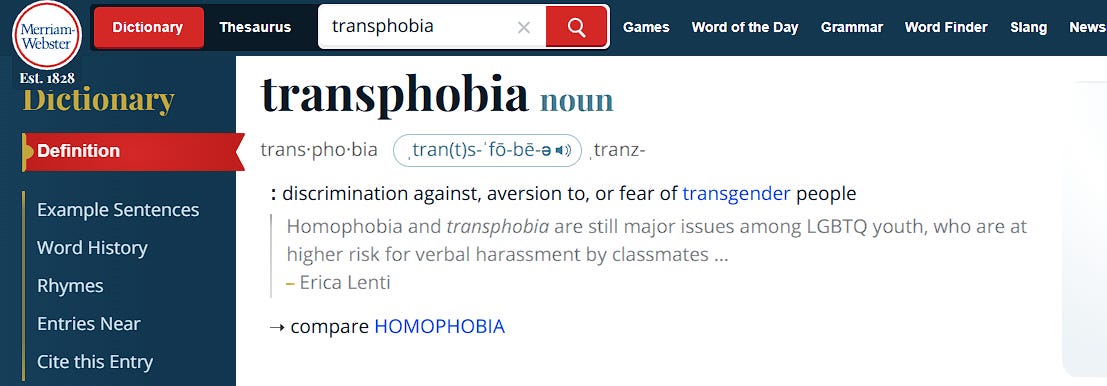
Let’s talk through four examples of transphobia from one of his recent articles (and please note: there are quite a few articles of his to choose from on this topic), “Why the Dems need to bring common sense to the culture wars.”
1. He calls trans women “biological males.”
In his article, Winters writes “trans women, who are biological males.” This is not the neutral scientific language Winters seems to think it is. “Biological male” can mean a number of different things: chromosomes, reproductive anatomy, hormone levels, secondary sex characteristics, or some combination of them. Those characteristics do not always neatly align, and medical transition often substantially changes a person’s hormone profile and secondary sex characteristics. In other words, transition affects our biology.
So why insist on the phrase “biological male”? Because in this context, it isn’t actually being used to communicate a piece of medical information. It is being used to make a categorical statement about who trans women really are: not women, but “biological males.” The term tells us remarkably little about someone’s actual biology while telling us quite a lot about how the speaker wants us to understand someone’s gender.
Why this is transphobic: It invalidates trans women’s gender identity and uses their transgender status as the basis for exclusion.
2. He argues that trans women should be separated from women’s sports.
Winters argues that “there are some distinctions that matter in a sport — strength, height, and, yes, sex,” before asking, “Could there not be sporting leagues specifically for trans athletes?” He compares this proposal to the Paralympics.
The obvious problem is that this does not merely raise a question about how individual sports should establish eligibility rules. He is suggesting structural segregation of transgender people from the category in which they identify and live.
And the fairness question is considerably more complicated than Winters acknowledges. As I wrote in my review of the book Fair Game: Trans Athletes and the Future of Sports for NCR, athletic advantage has always existed in countless forms — strength and height are not so binary as he seems to imply. Trans athletes are also an extraordinarily small proportion of competitive athletes – certainly not enough to sustain a standalone league. The book (which I highly suggest reading, it includes great research and firsthand accounts from transgender athletes) makes a compelling case that the political fixation on trans athletes distracts from the longstanding issues actually undermining women’s sports, including underfunding and unequal resources.
Why this is transphobic: It treats transgender identity as a basis for segregation and exclusion from participation in sports.
3. He invokes trans women as a threat to “safe spaces” for cisgender women.
Winters refers to “the added concern for young women to have safe spaces in locker rooms and lavatories.”
This is one of the oldest and most persistent forms of anti-trans rhetoric: the suggestion that trans women represent an inherent threat to cisgender women simply by being present in women’s spaces. But the research does not support it. Studies have found no evidence that allowing transgender people to use facilities consistent with their gender identity increases rates of violence, assault, or privacy violations. In fact, the documented safety risks run in the opposite direction: transgender people are more likely to experience harassment, assault, or denial of access when they are forced to use facilities according to their sex assigned at birth.
Notice that Winters’ argument does not require a trans woman to actually do anything harmful: her identity itself becomes the source of suspicion and even danger.
Why this is transphobic: It stigmatizes trans women as potentially dangerous or inappropriate in public spaces and provides justification for excluding them from facilities consistent with their gender.
Related: There are many cisgender women who are comfortable sharing spaces with transgender women. Here’s one account, “An accomplished soldier, fired for no reason” by Anna Keating
4. He treats trans equality as a political liability.
Winters’ article is ultimately concerned with whether supporting us is politically advantageous. He describes trans issues as a “totem” of the culture wars, calls the positions of Democratic politicians “extreme” (despite the fact that there is no consensus amongst democrats — they do not all hold the same position on trans rights), and argues that Democrats need to distance themselves from organizations and activists advocating for trans rights.
What is striking is the hierarchy of whose concerns count. The concerns of cisgender people are treated as self-evidently legitimate. The concerns of transgender people, on the other hand, are entirely dismissed as a kind of political posturing. This is the key strategy Winters employs: constantly reducing transgender people to a talking point so that he never has to reckon with the realities of our lived experience.
Why this is transphobic: Transphobia does not require hatred. It can also operate by treating one group’s dignity and rights as negotiable while treating another group’s comfort and preferences as the default. When a marginalized group’s equality becomes something politicians are encouraged to abandon because voters might respond negatively, that is not neutrality. It is systemic discrimination.
Catholicism Has Something to Say About This
Fortunately, another writer at the National Catholic Reporter, Daniel Horan, recently took on MSW with a response that is actually Catholic.
Dan brings the conversation back to the fact that transgender people are not a “cultural issue,” a political liability, or a collection of abstractions against which everyone else’s feelings and anxieties must be weighed. We are people. And from a Catholic perspective, that should be the beginning of the conversation.
One of the foundational principles of Catholic Social Doctrine is the inherent and inalienable dignity of every human person. That dignity is not contingent upon whether a person’s existence is politically convenient, whether the majority finds them confusing, or whether accommodating them requires other people to rethink assumptions they have long taken for granted (what Winters would call “common sense”). Human dignity does not operate according to a hierarchy in which cisgender people’s discomfort, fears, or sense of normalcy automatically outrank transgender people’s ability to access healthcare, participate in public life, or live openly as themselves. Pope Francis understood this, which is why he supported civil unions for homosexual couples.
Catholic Social Doctrine does not begin by asking whether protecting a vulnerable minority is good politics. It begins with the recognition that every human being possesses inherent dignity and that our social and political structures should reflect that reality.
That does not mean every practical question involving transgender people has a simple answer. Dan, for instance, leaves room in his article for good-faith discussions about how communities can become more inclusive. But there is a profound difference between discussing how to uphold the dignity of transgender people and beginning with the assumption that our dignity is itself negotiable.
Conclusion
Perhaps the most revealing part of Winters’ argument is the way he describes ordinary solidarity with marginalized people as something that “makes Democrats sound weird” and “reeks of virtue signaling.” He says that he receives “nasty emails” when he writes about this, tone policing those who are rightly angered at his failure to recognize the dignity of transgender people. Then, he turns around and uses his own inflammatory language, declaring “it is time to stop the cultural nonsense.” It’s hard not to read that as an implication that transgender people ourselves are the “nonsense” he’s referring to.
The strategy is, Winters makes a political argument that dehumanizes a real marginalized group of people but deflects any responsibility for that dehumanization by referring back to the political container. Even if this wasn’t such a disingenuous rhetorical move, it remains a bad faith attempt to delegitimize concerns about transgender rights in the public square. He waves away his critics as emotionally motivated for rising to the defense of a real group of people that he has reduced to a “totem.” If the subject of your argument is actual human beings, then their dignity cannot become “nonsense” simply because defending it makes a political party sound unfashionable or costs it votes. Calling attention to the dignity of people who are routinely marginalized is not virtue signaling. It is, at its best, an expression of the most basic moral commitments of Catholic Social Doctrine.
Political arguments are never morally neutral when their subject is the rights and dignity of a marginalized group. When the proposed political strategy is to distance ourselves from trans people, restrict their participation, question their identity, and treat their equality as an electoral liability, the result is a political party that has abandoned a small group of people in order to curry favor with those who dehumanize us. And that is why calling this transphobia is not an accusation of personal hatred. It is an honest description of the consequences of the framework he is defending.
There is, indeed, room for nuance. There is room for disagreement about policy, for ongoing research, and for good-faith debate about difficult questions. But nuance cannot mean asking transgender people to accept that our rights, dignity, and participation are negotiable whenever they become politically inconvenient. If Catholicism means anything in this conversation, it means that we begin somewhere else: not with the polling numbers, not with the culture wars, and not with whether trans people make anyone feel “weird,” but with the person standing in front of us. We are not a cultural issue. We are people.
Thank you for this, Maxwell. Big fan of your work. I am not Catholic but I enjoy reading NCR, and I have consistently been put off by the condescension and arrogance in his writing...I didn't even know about his blatant transphobia but I can't say that I am surprised. I am glad that you are also a columnist for NCR & that a larger audience will be hearing your voice.
Thank you for this. It is very frustrating when people present themselves as authorities on this issue when they seem to have thought about it for about 5 minutes. If I had $1 for every commentator who invokes 'biological' arguments against trans rights but never engages with the physical and biochemical impacts of HRT, I would be very rich......