


When it comes to transphobia, I have experienced a little bit of everything. Cold shoulders from former friends and rude words from anonymous online accounts. Rejection from family who had previously told me they’d love and support me always. Kind words from well meaning Catholics who eventually turned around and platformed writers and speakers who would prefer to restrict my legal rights and throw me out of their church.
Luckily, this hasn’t been my only experience (though for some trans Catholics it is all they’ve known). I have found community: friends and mentors who love and support me exactly as I am, without any ifs, ands, or buts.
I want to be clear how this topic fits into our High Control Catholicism series. I grew up in the kind of Catholic environment designed to prevent queer people from existing: yet here I am. Some have assumed I grew up as a cafeteria Catholic, but Sunday mass and the sacraments were the foundation of my life. I went to private Catholic schools until fifth grade and was then homeschooled by my Catholic parents all the way through high school. I always raised my hand to answer the questions no one else could in CCD. I even attended Franciscan University of Steubenville. In my world, LGBTQ people might as well have been aliens—not part of my world, yet I was confident of their sinfulness.
Though unlikely, I made it out of this tightly controlled universe. I learned to hear the still, quiet voice of God gently drawing me close, full of truly constant and unconditional love—a love I relied on intimately during the early years of my transition when all of the Catholics I had known scattered to the wind. As those people faded away, I drew closer to Christ.
So yes, I know church teaching. When the theology you were raised in threatens to deny your existence, it becomes a matter of survival to study it deeply.
And while undertaking this study, I have identified two particularly troubling errors.
The First Error: Battling Ideas While Ignoring People
The major transgender boogeyman for Catholics is “gender ideology.” Picture: a candlelit meeting of robed figures in a stone room with smokey incense floating through the background—wait, that’s just regular Catholicism. But the idea of gender ideology is that there is a secretive, unified force of people who all want to destroy the church and everything it stands for by attacking heteronormative definitions of gender and sexuality.
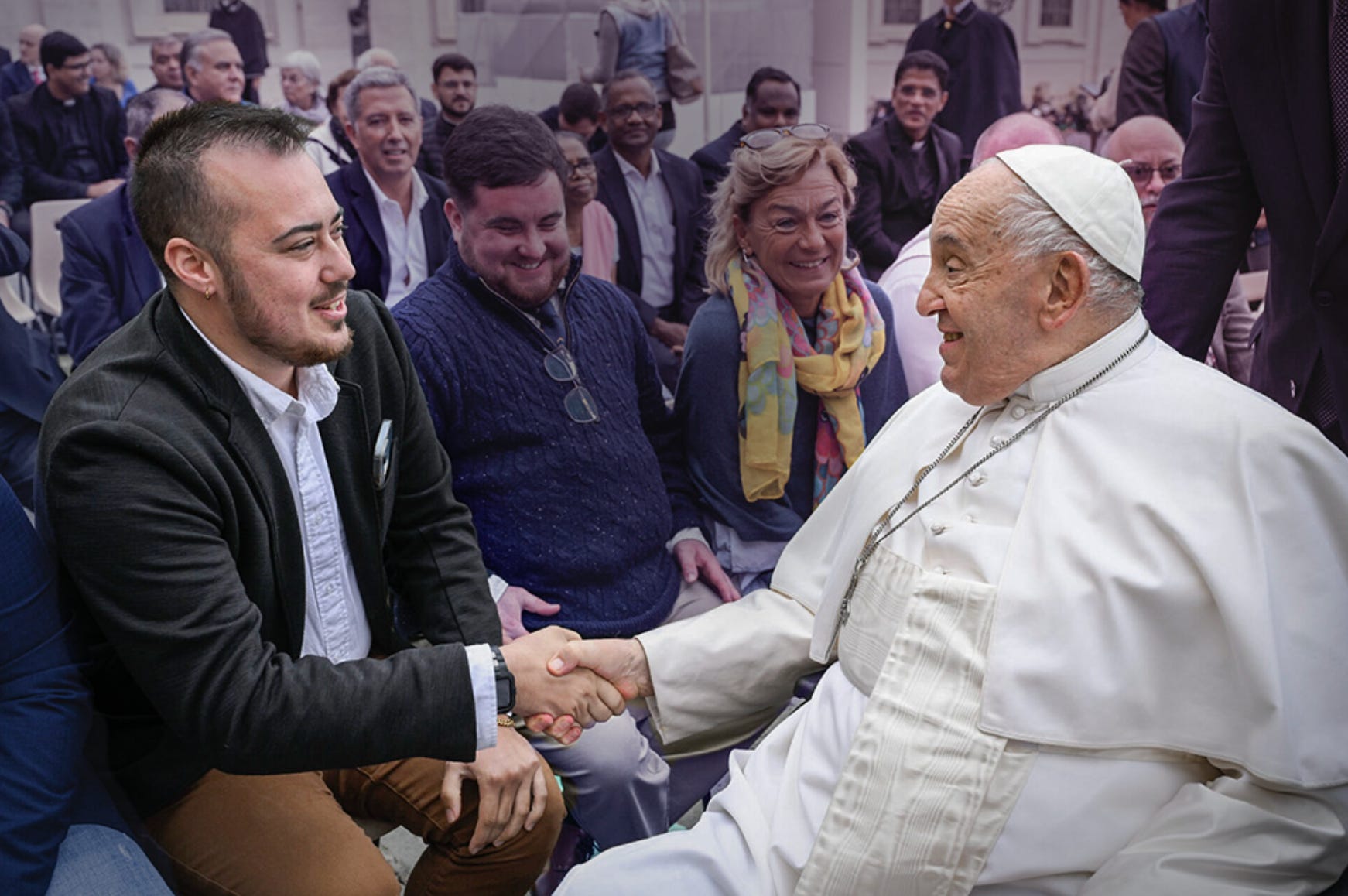
Just ask Pope Francis, who was deeply pastoral (I even got to meet him) and advanced discussions of trans lives through public meetings with transgender people, but also said gender ideology is today’s “worst danger.” This is the first error: that gender is an ideology. The Vatican itself uses the word ideology in Dignitas Infinita, a document released in 2024 that unequivocally opposes gender affirming care despite clear evidence that it is suicide prevention.
Never mind the consensus of medical experts and the scientific community. Never mind the history proving transgender people have always been amongst us. The insistence on gender as ideology is a rhetorical loophole—a signature Catholic gambit for avoiding accountability on any topic that might require more nuance than it was previously afforded.
If gender is an ideology, a belief system, then Catholicism is ready on deck to go toe-to-toe, providing scripture and tradition as evidence that boys and girls are made that way from the beginning and must never deviate from these assigned roles (ignoring of course that both scripture and tradition include many who do not support this claim, and the existence of nonbinary and intersex people). These theological arguments are ultimately unconcerned with the reality of trans lives because our lives are irrelevant to the argument they’re making.
This “ideology” framing conveniently removes trans people themselves from the conversation. In certain Catholic circles, “gender ideology” functions as a dog whistle—coded language that mobilizes an in-group without attracting outside criticism. Instead of explicitly denying rights to trans, nonbinary, and intersex people, the term turns us into an abstract concept to be debated away.
Jane Fae, chair of Trans Media Watch and director of TransActual UK, points out other common dog whistles that can be seen in Catholic circles like “family values” and “trans-identified.” Researchers at the University of Washington have shown how coded terms can serve as stand-ins for deeper prejudice–cries of “anti-Christian bias” acting as a proxy for defending white supremacy.
This troubling failure to welcome and love transgender people in the example of Jesus is particularly prevalent amongst terminally online Catholics and the consequences of this prioritization of debate over people leads to outcomes like the radicalization seen in the manosphere. Jane Fae agrees, urging people to look at how speakers engage with an anti-trans audience, specifically when people claim to be “engaging in debate” while continuing to use these dog whistles. “So, when you see it, call it out.”
And this is where High Control Catholicism and transphobia start to harmonize: both fixate on defending an abstract “truth” while stepping over the actual people in front of them.
The Second Error: Manufacturing Regret
Once gender is framed as an ideology, the conversation naturally shifts to conversion narratives. In Catholic terms, regret is the first step in the testimony: reject your “belief in gender ideology,” and you can embrace Catholicism as the superior truth.

This creates a demand for regret stories—no matter how rare they actually are. The U.S. “DeTrans” movement follows the same playbook as traditional conversion therapy for sexuality: platform a few voices who express regret to suggest the whole community is misguided. Julia Serano notes that only 1–3% of people who transition experience regret, far lower than for most medical procedures. Yet anti-trans media manipulates the numbers, cherry-picks outlier studies, and insists “things are different now.” And as former detransitioners are saying, this movement, like the traditional conversion therapy one surrounding same-sex attraction, is deeply problematic.
Far-right actors remain convinced that regret is higher than is being reported. In fact this past April, the Trump administration ordered the NIH to research trans regret. A number of studies have already shown that regret about transitioning is extremely rare, but what this administration does in ordering additional studies is lean on its own confirmation bias to argue that a result should appear. As Harry Barbee, assistant professor at the John Hopkins Bloomberg School of Public Health, told NPR, “phrase[s] like ‘regret’ and ‘detransition’ can be weaponized.”
Even if the rate were marginally higher, it wouldn’t justify dismantling care. But as we’ve seen in High Control Catholicism, confirmation bias rules the day. This isn’t just bad science, it also harms people. Regret narratives serve the same function here as they do in high-control religion: to validate the system’s superiority and erase those who are living happy, thriving lives outside it.
Inside the Force Field
Together, these two Catholic errors about gender create a kind of force field that prevents the truth (science and history) from permeating this world where everything that you personally disagree with is a belief system. Within the force field, gender becomes stereotypes that have no bearing on biology (or reality), and theology is wrongly given priority over scientific inquiry.
As we have shown throughout the High Control Catholicism series, this is not an isolated phenomenon. The reframing of reality into “belief systems” to be battled—rather than human beings to be encountered—is a hallmark of religious control. It allows Catholics in positions of authority to avoid genuine engagement with marginalized people while claiming theological orthodoxy. In practice, it’s less about faithfulness to Christ and more about fortifying an ideological fortress where no inconvenient truths can enter.
These two errors—imagining gender as an ideology and hinging opposition to trans people on regret narratives—are not simply misunderstandings. They are tools that uphold a system invested in maintaining rigid gender hierarchies, regardless of the human cost. They flatten the depth of human experience into debate fodder and turn pastoral care into performance.
And so we now dig deeper into the way anti-trans sentiment shows up through gender essentialism and trans-exclusionary radical feminism.
Gender Essentialism: The Soil Where TERFism Grows
Gender essentialism—the belief that men and women are fundamentally, biologically different in fixed ways—is the theological and cultural soil from which both Catholic transphobia and TERF (Trans Exclusionary Radical Feminism, defined below) ideology grow. In Catholic discourse, it’s framed as “just the way God made you.” In TERF discourse, it’s the rallying cry that womanhood is reducible to certain reproductive capacities and anatomy. Both approaches treat narrow, socially constructed stereotypes as if they were natural law, cloak them in the language of science or feminism, and erase anyone—cis or trans—whose lives expose the limits of their definition.
Essentialism in its broadest sense is the idea that categories of things have some built-in, defining essence that makes them what they are. Apply that to gender, and you get the claim that men and women have innate traits that explain why men are “naturally” better leaders, priests, or protectors, while women are “naturally” better nurturers, mothers, or helpers. Conveniently, these “natural” traits always line up with whatever roles the institution already wants you to occupy.
The problem? None of it holds up to serious scrutiny. Research shows that acting out these gender essentialist beliefs predicts prejudice against trans people. Gender essentialism oversimplifies human diversity, reducing people to one-dimensional caricatures. It ignores the huge role that culture and social conditioning play in shaping how we understand gender. It’s a handy tool for justifying inequality—if God made men for the pulpit and women to serve them (even nuns and women in religious orders), then any push for equality is framed as rebellion against divine order.
A good example from the Christian world this past week was when Defense Secretary Pete Hegseth reposted a CNN interview with far-right conservative pastor Doug Wilson, co-founder of the Communion of Reformed Evangelical Churches.
In the video, Wilson perfectly demonstrates the danger of gender essentialism—that women should not be allowed to vote and should be relegated to the hearth and home, and further in an interview with fellow conservative Michael Foster, that even if a woman could give a better sermon than a man, “it wouldn’t be fitting with the nature of their being.” Foster sums up gender essentialism well with his horrifying comment: “You can nail a nail in with a wrench—I’ve had to do it before—but that’s not what a wrench is for.”
Gender essentialism conflates sex and gender, pretends science is on its side, and treats cultural norms as unshakable reality. When embedded in theology or feminist rhetoric, essentialism becomes even harder to challenge because it presents itself as the defense of truth rather than the reality: it is an imposition of control
A Look at TERF Logic
Trans-exclusionary radical feminism (TERF) defines womanhood strictly by natal sex, rejecting gender identity and treating biology as destiny—unless biology complicates their narrative, in which case they ignore it. Intersex people exist at rates comparable to natural redheads. Hormone therapy works because human DNA already contains the biological pathways needed for many of the physical changes in gender transition. Secondary sex characteristics are hugely variable beyond what stereotypes would lead you to believe. Biology is dynamic, but TERF ideology needs it to be static to survive.
The core tenets—sex-based definitions, rejection of gender identity, opposition to trans rights, coded language, and a “protection” framework—are dressed in feminist branding but enforce the same boundaries Catholic leaders guard in religious language. And just as in High Control Catholicism, this “protection” rhetoric often means locking arms with conservative forces that also oppose key feminist stances on abortion, contraception, and women’s autonomy.
The irony couldn’t be clearer: self-proclaimed “protectors of women” aligning with the very political machine that’s rolling back women’s rights.
The Core Tenets of TERF Ideology
•Sex-based definition of womanhood: Womanhood is defined exclusively by the biological classification assigned at birth, with gender understood solely in terms of natal sex rather than lived identity or experience. This invalidates the existence of intersex people, nonbinary people, and all gender expansive people, as well as the existence of many cisgender people–people like Emma, who has PCOS–whose bodies do not function as TERFs and others prescribe women should.
•Rejection of gender identity: Gender identity is dismissed as a harmful social construct—while TERFs simultaneously enforce their own rigid gender norms. This invalidates their own argument–gender is an identity that deeply impacts the ways in which women are treated because of their gender, and are policed for how they express their gender.
•Opposition to transgender rights: This includes restricting trans women’s access to women’s spaces, blocking gender-affirming healthcare, and resisting legal recognition of trans people. Like Men’s Rights Activists who claim feminism threatens their rights, TERFs argue that acknowledging trans lives—and the violence they face—somehow diminishes women’s struggles against sexism and misogyny, erasing solidarity efforts between marginalized groups.
This is false dichotomy because rights are not a finite resource: protecting one marginalized group strengthens protections for all. It’s dangerous because it pits marginalized communities against each other, erodes solidarity, and fuels policies that strip rights and safety from both women and trans people.
•Coded language and in-group terms: Common phrases include “gender critical,” “adult human female,” and derogatory acronyms. This form of gender policing has the same effect as identifying women by whether they can have children–many cis women cannot have children but enforcing that only women who menstruate or can have children are women denies the entire reality of people with PCOS and hormone disorders. The use of coded language is not only a red flag for high-control behavior in rejecting inclusive language, but also shows how much TERF logic depends on bullying and social shaming to enforce conformity.
•Framing as protection: The language of “protecting women” masks the goal of preserving a definition of womanhood that excludes anyone who challenges their worldview—so really, they only want to protect certain women.
Trans women are not a threat to cis women or women’s spaces, nor to the efficacy of women’s sports–in fact, the greatest threats against women athletes are trainers and people within the sports world that systematically sexually abuse women whose own systems cover up and conceal their abuse and refuse to hold them accountable.
Regarding athletes, according to NCAA President Charlie Baker, there are fewer than 10 transgender student-athletes competing in the NCAA's more than 500,000 student-athlete population. This number represents less than 0.002% of the total number of college athletes. As Shiwali Patel, Senior Director of Safe and Inclusive Schools wrote for the National Women’s Center, the “Protection of Women and Girls in Sports Act” seeking to exclude trans women from sports perpetuates abuse and sexism.
Why It’s Harmful
TERFism and Catholic transphobia don’t just harm trans people—they give cultural permission to police anyone who doesn’t “look” the part; they enforce purity tests (deciding who’s an insider and who’s viewed as an outsider). TERF ideology has been roundly rejected by mainstream feminist and LGBTQ+ movements as nothing more than repackaged transphobia. It’s not just talk — it has driven harassment campaigns, rolled back hard-won protections, and emboldened violence against trans people.
And here’s the bitter punchline: these self-proclaimed “protectors of women” routinely lock arms with the very right-wing, anti-feminist forces waging war on women’s rights everywhere else — standing shoulder to shoulder with the same political machine that would gladly send women back to the kitchen. It’s reminiscent of conservative activists like Phyllis Schlafley, a Catholic who lived a “modern woman in the workforce” lifestyle while simultaneously actively campaigning against it for other women–pulling the ladder up behind her.
Her campaign convincing housewives that their roles and rights would be threatened by the passing of the Equal Rights Amendment closely mirrors how TERFs today warn that protecting the rights of trans people and their access to gender affirming care will threaten the rights of cis women.
At its core, TERFism isn’t just a debate about definitions. It’s a high-control belief system that uses the language of liberation to enforce exclusion. It flattens human diversity into a false binary, ignores inconvenient biological realities, and wields “science” selectively to defend a narrow ideology. When you strip away the feminist branding, what’s left is gatekeeping dressed as empowerment. The rhetoric claims to protect women, but in practice it polices identity, dictates who is worthy of safety and dignity, and decides who counts as a “real” woman. It turns rights and recognition into privileges doled out only to those who conform to its narrow rules. This isn’t protection; it’s the same exclusionary logic used to justify other forms of oppression, repackaged in the language of care.
And TERF ideology and more broadly transphobia harms everyone, not just trans people. In particular, anti-trans violence targets any woman who does not conform to gender policing standards, perhaps best seen in Imane Khelif’s treatment at the Paris Olympics and Michelle Peacock’s murder in Richmond, Indiana by her neighbor who claimed that she was “a male acting like a woman.” Peacock was a 59-year-old Black, cis-gender woman. In 2016, a cis woman was harassed in a Wal-Mart bathroom because the attacker assumed that she was trans. Many similar stories continue to come to light today.
As many members of the LGBTQ+ community share, transphobic legislation and violence hurts all people, especially cis women of color, who are not “seen” as cis. Creating an expectation and authority for people to harass and attack trans people is a real threat to all people.
Just like in high-control religion, the policing power doesn’t stop where you think it will. Once you normalize harassing and excluding trans people, you’ve normalized harassment as a tool—and everyone becomes vulnerable.
Conclusion: Breaking the Scripts

The pattern here is hard to miss. Whether it’s Catholics insisting that “transgenderism” (just a reminder: not a word) is an ideology, or TERFs declaring that biology fixes our fate, the goal is the same: to preserve a rigid system of gender hierarchy by recasting lived realities as threats to be neutralized. One fortress is built out of theology; the other is made of feminist slogans. But the blueprint is identical: turn stereotypes into law and then erase anyone who doesn’t fit.
And here’s where I come back in—not just as a writer, but as someone who’s lived through this. I know what it’s like to believe the fortress is protecting you, until you realize it’s keeping you from seeing the people outside and from living life on your own terms. I know what it’s like to have theology used as a weapon against your existence—and to watch the same weapon re-sharpened in “progressive” spaces that prop up “acceptable” outcasts as leaders while failing to protect the most marginalized members.
The Jesus I know didn’t cling to power or erase people to keep order. He stepped across boundaries, broke the scripts, and refused to lend legitimacy to those wielding harmful authority. If your theology—or your feminism—can’t survive meeting the people it condemns, the problem isn’t the people. It’s the belief system.
When people with Catholic authority–connections to the Vatican as reporters, leaders, and authors–associate with and share content by TERFs, they lend an air of credibility to it. Whether or not they realize that these people hold these beliefs, it is their responsibility to engage with and understand how their actions online and in-person can even unintentionally perpetuate transphobia. And when people realize that they are posting, reposting, or writing in support of TERF actors, it is their responsibility to take action, apologize, and make reparations for the harm they caused.
For example, LGBTQ+ writers this past week have withdrawn from the Polari First Book Prize because the list also includes a self proclaimed TERF author. As one of these authors Sacha Coward (who wrote Queer as Folklore) acknowledged in an Instagram post this past week, “I simply cannot continue with this in good faith.”
“This is supposedly an award for ALL LGBTQ+ folk. Celebrating inclusion. Not exclusion and division. My book is about ALL queer folk, it was supported by trans people and read by trans people. After the recent statement from Polari I find myself unsatisfied. I have to go with my integrity here just to be able to look myself in the mirror.”
This moment highlights the larger lesson: High Control Catholicism and TERFism are not isolated ideologies—they are two sides of the same coin. Both build fortresses designed to control, categorize, and exclude; both claim to protect or liberate while enforcing rigid hierarchies.
The antidote is the same in both cases: encounter people as they are, dismantle the systems that demand conformity, and refuse to let power masquerade as morality. True faith—and true feminism—cannot exist without stepping out of the fortress and meeting the people on the margins face to face, just like Jesus did.
Check out this episode of Theo’s podcast for a conversation that analyzes transphobia in a USCCB sponsored talk in 2024 Responding to Jason Evert on Trans Identities
Yes!!! There are so many people who love you dearly, Max! It's one of the great joys of my life to see how you have been able to let God out of the box.......so many of us grew up with God confined to various boxes designed by small-minded (mostly) men. Not just Catholicism, but also evangelical fundamentalism as I experienced. One raised with such restriction only truly begins to live life fully when God is liberated from these chains. The world becomes place of wonder, beauty, spiritual richness, and possibility.